Having problems with your ECU, ECM, PCM or engine control module?
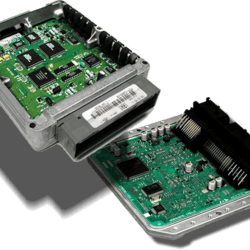
The Engine Control Unit (ECU) is one of the most important electronic components in a modern vehicle. It controls or communicates with critical engine systems including fuel injection, ignition timing, turbocharger control, emissions systems, throttle operation, sensors and engine management.
A faulty ECU can cause anything from an engine warning light or intermittent starting problem to a complete no-start condition or loss of communication with diagnostic equipment.
At AutoPulse247, we supply genuine used OEM ECUs, ECMs, PCMs, DME, DDE and engine control modules for a wide range of vehicles. Our existing ECU inventory includes genuine units from manufacturers such as Bosch and vehicle applications including BMW, Audi, Mercedes-Benz, Volkswagen, Saab, Fiat and Land Rover.
These terms are often used when searching for an engine computer:
ECU – Engine Control Unit
A general term for the electronic control unit responsible for engine management.
ECM – Engine Control Module
Another common name for the computer controlling engine operation.
PCM – Powertrain Control Module
On some vehicles, a single module can control both engine and transmission-related functions.
Manufacturers also use their own terminology.
For example:
BMW – DME / DDE
Mercedes-Benz – ME / CDI / CR ECU
Volkswagen / Audi – Engine ECU / ECM
Ford – PCM
Vauxhall / Opel – ECU / ECM
When searching for a replacement, these terms may refer to similar engine-management computers, but compatibility must always be confirmed using the exact part number.
A failing ECU can produce many different symptoms.
Common bad ECU symptoms include:
An ECU fault can sometimes appear to be a mechanical engine problem, so proper diagnosis is important before replacing the module.
Some diagnostic trouble codes are particularly relevant when investigating possible ECU or engine control module problems.
Indicates a communication problem involving the control module and other electronic systems.
Possible causes include:
P0601 indicates that the control module has detected a problem involving its internal memory or checksum.
Possible causes can include:
This code can indicate a problem with ECU programming or calibration data.
It may occur after:
Programming or reprogramming should be investigated before automatically replacing the ECU.
P0603 relates to the ECU's Keep Alive Memory.
Possible causes include:
This code indicates that the ECU has detected an issue involving its internal Random Access Memory (RAM).
Power supply and voltage should be checked before condemning the ECU.
P0605 indicates a problem involving the ECU's internal Read Only Memory.
Possible causes include software corruption, programming issues or an internal control-module problem.
P0606 is one of the most important codes associated with possible ECU failure.
It indicates that the control module has detected a processor-related malfunction.
Possible symptoms include:
However, power supply, grounds, battery condition and wiring should be checked before replacing the ECU.
P0607 indicates that the control module has detected an internal performance problem.
Possible causes include:
This code can indicate an internal ECU processor or monitoring problem.
It may require investigation of the ECU power supply, software and internal electronics.
P060B can relate to internal processing of sensor signals within the control module.
Do not replace the ECU without checking relevant wiring, voltage supplies and sensor circuits.
This code indicates that an internal processor performance problem has been detected.
It can potentially be caused by ECU hardware, software or electrical supply problems.
This can occur when an ECU has incorrect vehicle configuration or programming.
It is particularly important after ECU replacement or programming.
This code can occur when the Engine Control Module and Transmission Control Module configuration is incompatible.
Possible causes include:
P062F is another important ECU-related code.
EEPROM memory can contain important configuration and calibration information.
Possible causes include:
U0100 is a commonly encountered communication code.
It means another vehicle module has lost communication with the ECM/PCM.
Possible causes include:
A U0100 code does not automatically mean the ECU is defective.
These codes can make an internal ECU problem more likely, but the fault code alone is not enough to prove that the ECU has failed.
Before replacing the ECU, check:
Low or unstable voltage can contribute to internal-control-module codes, so electrical supply checks are particularly important.
One of the most common ECU problems is “No Communication With ECU” or “No Communication With ECM/PCM.”
A diagnostic scanner may be unable to access the engine control module even though it can communicate with other modules.
Possible causes include:
No ECU power supply
A fuse, relay or wiring fault can prevent the ECU from switching on.
Poor ECU ground
A damaged or corroded ground connection can cause complete or intermittent ECU failure.
CAN Bus fault
Communication wiring problems can prevent the ECU from communicating with other modules.
Water damage
Moisture or corrosion inside the ECU or connectors can damage electronic circuits.
Internal ECU failure
Processor, memory or power-supply components inside the ECU can fail.
A replacement ECU should only be considered after external electrical problems have been checked.
Yes, but there are many other possible causes.
A crank-no-start condition can also be caused by:
If diagnostic testing shows no communication with the ECU, missing injector control, missing ignition control or internal ECU fault codes, further ECU testing may be necessary.
Engine control modules are designed to last for many years, but failures can occur due to:
Water or moisture damage – one of the most damaging conditions for electronic control modules.
Incorrect voltage – alternator or charging-system faults can expose electronics to abnormal voltage.
Low battery voltage – unstable supply voltage can cause communication and programming problems.
Short circuits – damaged wiring, injectors, actuators or solenoids can overload ECU driver circuits.
Corrosion – water ingress into connectors can damage ECU terminals and internal electronics.
Heat and vibration – repeated thermal cycling and vibration can contribute to electronic component or solder-joint failure.
Incorrect jump starting – reverse polarity or voltage spikes can damage electronic modules.
Programming failure – interrupted or incorrect flashing can leave an ECU unable to operate correctly.
Water-damaged ECUs are common on vehicles where the engine computer is located in the engine bay, plenum chamber or another area exposed to moisture.
Signs can include:
If water caused the original ECU failure, the source of the water ingress should be repaired before installing another ECU.
AutoPulse247 supplies genuine used OEM engine control modules for petrol and diesel vehicles.
Depending on the manufacturer, you may see terminology such as:
ECU – Engine Control Unit
ECM – Engine Control Module
PCM – Powertrain Control Module
DME – Digital Motor Electronics
DDE – Digital Diesel Electronics
Engine Computer
Engine Management Module
Injection Control Unit
These are useful search terms, but the exact OEM part number is the most important information when selecting a replacement.
OEM engine control modules are produced by several major automotive electronics manufacturers.
Common ECU manufacturers include:
Bosch
Continental
Siemens / Siemens VDO
Delphi
Denso
Magneti Marelli / Marelli
Hitachi
Keihin
Common ECU families can include:
Bosch EDC15 / EDC16 / EDC17
Bosch MED / ME / MG1 / MD1
Siemens / Continental SID
Delphi DCM
Marelli IAW
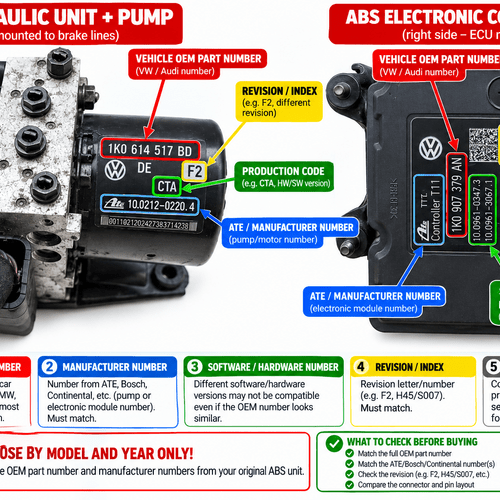
When purchasing a replacement, compare both the vehicle manufacturer's OEM number and the ECU manufacturer's number whenever possible.
AutoPulse247 already carries examples such as Bosch EDC17, Bosch MED and Bosch ME engine-management units, so these search terms align directly with your actual inventory.
Do not purchase an ECU based only on:
Make + model + engine + year.
The same vehicle can use different ECU hardware and software versions.
Check the label on your original ECU for:
For example, Bosch numbers often begin with formats such as:
0 261 ...
0 281 ...
But the complete number matters.
An ECU that looks identical and uses the same connector can still be incompatible with the vehicle.
Often, yes.
A used replacement ECU may require:
Requirements depend on the vehicle manufacturer and ECU generation.
Some specialists can clone the original ECU data into a compatible replacement ECU, allowing important configuration, immobiliser and vehicle-specific data to be transferred.
Do not assume that a used ECU will be plug-and-play simply because the part number matches.
ECU cloning involves transferring relevant electronic data from the original ECU to a compatible donor unit.
Depending on the ECU, this can include:
This can be useful when the original ECU electronics have failed but its data can still be recovered.
The procedure should be carried out by a qualified automotive electronics specialist.
Sometimes an ECU may have a superseded or compatible replacement number, but never assume compatibility based only on appearance or ECU family.
Different part numbers can indicate differences in:
Always verify compatibility before installation.
A genuine used OEM ECU can be a cost-effective alternative when a new control unit is extremely expensive or no longer readily available.
AutoPulse247's ECU category currently contains genuine used OEM engine-management modules identified by their OEM and manufacturer part numbers.
When buying a used ECU, the key points are:
At AutoPulse247, we supply genuine used OEM:
Engine Control Units (ECU)
Engine Control Modules (ECM)
Powertrain Control Modules (PCM)
BMW DME modules
BMW DDE modules
Diesel engine ECUs
Petrol engine ECUs
Bosch EDC engine control units
Bosch MED / ME engine control units
Continental / Siemens engine ECUs
Delphi engine control modules
Denso engine control units
Our current catalog already includes engine-control units for several major European vehicle manufacturers.
The fastest way to identify the correct replacement is to send us:
Your VIN + vehicle make/model/year + engine size or engine code + ECU fault codes + complete OEM part number + manufacturer number + clear photographs of the original ECU label.
We can compare these details with our available stock and help identify a suitable replacement ECU.
Browse Used ECU Engine Control Units at AutoPulse247
Important: ECU fault codes and symptoms are provided for general diagnostic information. A fault code alone does not confirm that the ECU, ECM or PCM is defective. Battery voltage, power supplies, grounds, wiring, CAN communication, sensors and related components should be properly tested before replacing an engine control module.